

Mid-career crises happen when skill growth, confidence, and sense of purpose stop keeping pace with a person’s career stage—usually 10 to 20 years into working life. They can be prevented and resolved through consistent upskilling: closing technical skill gaps and investing in personality development training or classes to rebuild communication, confidence, and adaptability.
There’s a particular kind of quiet dread that shows up somewhere between your late thirties and early fifties. You’re not new to the workforce anymore. You’ve built a career, maybe a reputation, maybe a title with some weight to it. And yet, on a random Tuesday evening, you find yourself staring at your laptop wondering: is this it?
This feeling has a name—mid-career crises—and it’s far more common, and far more preventable, than most professionals realize. It doesn’t mean something has gone wrong with you. It usually means something has gone unaddressed for too long: skills that haven’t kept pace, ambitions that were quietly shelved, or a sense of identity that got too tightly wound around a job title.
The good news is that mid-career crises aren’t inevitable, and they aren’t a life sentence when they do happen. With the right upskilling strategy—one that treats capability building as ongoing infrastructure rather than a one-time fix—most professionals can navigate this phase with far more clarity and far less anxiety. This article breaks down why mid-career crises happen, what they actually look like, and how deliberate upskilling can prevent or resolve them.
What Exactly Is a Mid-Career Crisis?
A mid-career crisis is a period of professional disorientation that typically hits people roughly 10 to 20 years into their working life. It’s distinct from simple job dissatisfaction or burnout, though it often overlaps with both. It’s characterized by a deeper questioning: of direction, of relevance, and sometimes of purpose.
Common signs include:
- A persistent feeling of being stuck or stagnant despite years of experience
- Growing anxiety about being “left behind” by younger, more tech-fluent colleagues
- A sense that your skill set, once cutting-edge, is now merely adequate
- Difficulty picturing what the next 10-15 years of your career could look like
- Reduced motivation, even in roles that once felt engaging
- A nagging comparison to peers who seem to be advancing faster
Unlike a quarter-life crisis, which is often about figuring out what to do at all, a mid-career crisis is about reconciling what you’ve already done with what still feels unresolved. You have momentum, but you’re no longer certain it’s pointed in the right direction.
Why Mid-Career Crises Happen: The Root Causes?
Understanding why mid-career crises happen is the first step toward preventing them. They rarely stem from a single event—they build gradually, from a combination of structural, psychological, and organizational factors.
1. Skill Obsolescence Creeps In Silently
Industries evolve faster than most people update their capabilities. Someone who was an expert in their function a decade ago may find that the tools, frameworks, and even the vocabulary of their field have shifted underneath them. This isn’t a personal failing—it’s the natural consequence of technical and managerial evolution outpacing casual, on-the-job learning. When people don’t proactively invest in structured learning, the gap between “what I know” and “what the market needs” widens every year until it becomes impossible to ignore.
2. The Career Ladder Gets Narrower
Early career growth often feels linear: promotions, raises, and expanding responsibility arrive predictably. By mid-career, that ladder narrows dramatically. Fewer senior roles exist than mid-level ones, and competition for them is fierce. This structural bottleneck creates genuine uncertainty about whether continued effort will translate into continued advancement, which is deeply demotivating for people who have built their identity around forward momentum.
3. Identity Fusion With Job Title
Many professionals unconsciously build their sense of self around their professional role. When that role plateaus, feels threatened, or simply stops evolving, it can trigger something close to an identity crisis. This is one of the more overlooked reasons mid-career crises happen—the issue isn’t only external circumstances, but the internal story someone has attached to their career trajectory.
4. Comparison and Social Signaling
Mid-career professionals are surrounded by visible markers of others’ progress—promotions announced on LinkedIn, younger colleagues moving faster, peers switching to seemingly more exciting industries. This constant, often distorted, social comparison amplifies self-doubt and can make ordinary career plateaus feel like personal failures.
5. Neglected Soft Skills and Adaptability
Technical competence alone stops being sufficient as people move into more senior, cross-functional, or leadership-adjacent roles. Many professionals reach a wall not because they lack domain expertise, but because they were never taught how to communicate persuasively, manage ambiguity, lead through influence, or adapt their working style to different teams and contexts. This gap is precisely where a lack of personality development training becomes most visible—not as a soft, optional add-on, but as a structural weakness in someone’s professional toolkit.
6. Life-Stage Pressures Compound the Problem
Mid-career often coincides with major personal responsibilities—raising children, caring for aging parents, financial obligations like mortgages—that reduce the bandwidth available for reinvention. This makes people more risk-averse precisely when their careers most need deliberate, sometimes bold, recalibration.

The Cost of Ignoring a Mid-Career Crisis
When mid-career crises go unaddressed, the consequences rarely stay contained to how someone feels at work. They tend to spill over into decision-making, relationships, and long-term financial planning.
Professionals who ignore these signals often make reactive decisions: abrupt resignations without a plan, avoidable conflicts with leadership, or years spent coasting in roles that no longer serve their growth. Others swing the opposite direction, over-committing to overwork as a distraction from the underlying dissatisfaction, which accelerates burnout rather than resolving it.
Organizations pay a price too. Disengaged mid-career employees are less likely to mentor junior staff effectively, less likely to champion change, and more likely to quietly disengage rather than actively contribute. Recognizing and addressing mid-career crises isn’t just a personal wellness issue—it’s a talent retention issue for employers as well.
How Upskilling Prevents and Resolves Mid-Career Crises?
The most effective antidote to a mid-career crisis isn’t a dramatic career pivot or an extended sabbatical—though those can help in some cases. For most people, it’s a sustained, intentional commitment to upskilling: rebuilding both technical relevance and personal effectiveness before stagnation sets in.
Rebuilding Technical and Functional Relevance
The first layer of upskilling addresses the skill-obsolescence problem directly. This means deliberately seeking out certifications, workshops, or structured courses in whatever domain shifts are reshaping your industry—whether that’s data literacy, digital tools, project management frameworks, or emerging technology relevant to your field. The goal isn’t to chase every trend, but to close the specific gaps that are quietly limiting your options.
Rebuilding Confidence and Interpersonal Effectiveness
The second, often underrated, layer is personal and interpersonal development. This is where structured personality development classes genuinely change the trajectory of a stalled career. These programs are designed to help professionals sharpen communication, build authentic executive presence, manage difficult conversations with more confidence, and present their ideas in rooms where influence—not just competence—determines outcomes. For someone whose technical skills are solid but whose confidence and communication have quietly eroded over years of routine work, this is often the single highest-leverage investment available. It doesn’t just add a skill; it restores the self-assurance that mid-career stagnation slowly wears down.

Reframing Career Identity Beyond a Single Role
Upskilling also does quiet psychological work: it reminds people that their value isn’t fixed to one job title or one narrow set of responsibilities. Learning something new—even something adjacent to your core function—reintroduces a sense of agency and forward motion that counteracts the “stuck” feeling at the heart of most mid-career crises.
Building a Peer Network Around Growth, Not Comparison
Structured learning environments, whether in-person workshops or cohort-based online programs, surround professionals with peers who are also investing in growth. This shifts the social comparison dynamic from “everyone else is ahead of me” to “we’re all actively building something,” which is a far healthier frame for navigating a career plateau.

Practical Ways to Start Upskilling Right Now
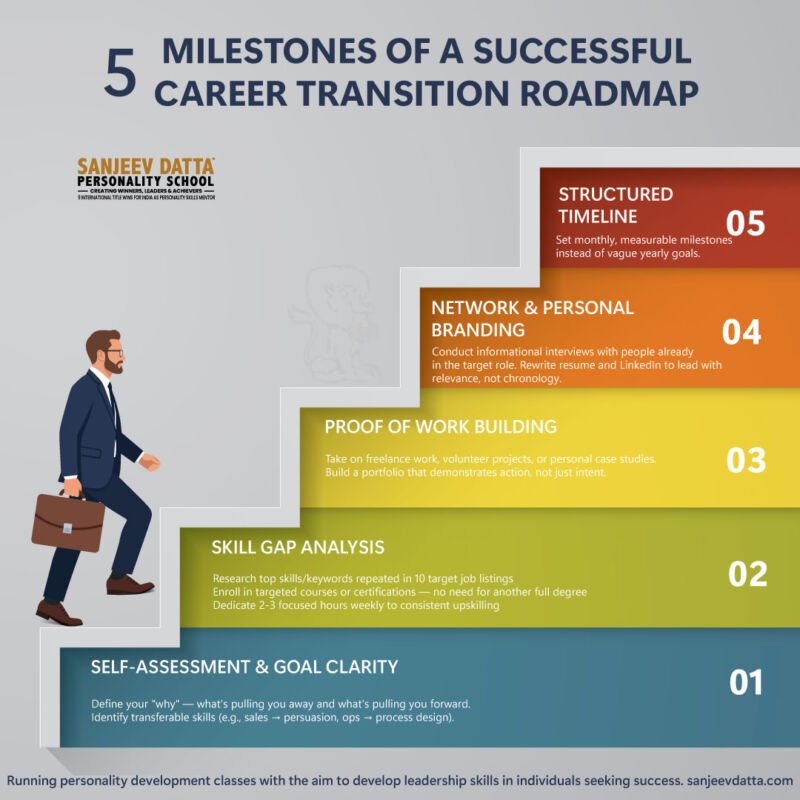
- Audit your current skill set honestly against where your industry is heading in the next 3-5 years
- Enroll in targeted personality development training to strengthen communication, leadership presence, and adaptability—skills that compound in value as you move into more senior or client-facing responsibilities
- Set a quarterly learning goal rather than a vague annual resolution
- Seek a mentor or coach outside your immediate reporting line for a more objective perspective
- Revisit your professional narrative—not just what you’ve done, but what you want the next chapter to look like
Making Upskilling a Habit, Not a Reaction
The professionals who navigate mid-career transitions most gracefully rarely treat learning as an emergency response to a crisis already in motion. They treat it as ongoing maintenance—the same way regular exercise prevents a health crisis rather than curing one after the fact.
This means building learning into your calendar the way you’d build in any other non-negotiable commitment: a course every quarter, a book on a genuinely new topic each month, a habit of asking for feedback rather than waiting for a performance review to reveal a blind spot. It also means being honest about which gaps are technical and which are personal—because the confidence, communication, and adaptability skills built through consistent personality development often matter just as much as technical expertise once you’re a decade or more into your career.
mentorship programs for female entrepreneurs
Frequently Asked Questions
Q. What are mid-career crises, and at what age do they usually happen?
Mid-career crises are periods of professional disorientation and self-doubt that typically occur 10 to 20 years into a person’s working life, often between the late 30s and early 50s. They involve questioning one’s direction, relevance, and long-term purpose rather than simple job dissatisfaction.
Q. What are the most common signs of a mid-career crisis?
Common signs include feeling stagnant despite years of experience, anxiety about being outpaced by younger colleagues, difficulty picturing the next decade of one’s career, reduced motivation, and a skill set that feels merely adequate rather than current.
Q. Can upskilling actually prevent a mid-career crisis?
Yes. Upskilling addresses both root causes of mid-career crises: technical skill obsolescence and eroded confidence. Closing functional skill gaps keeps a professional relevant, while personality development training rebuilds the communication and confidence needed to keep advancing.
Q. What is the difference between personality development classes and technical upskilling?
Technical upskilling closes gaps in domain-specific knowledge, tools, or certifications. Personality development classes focus on interpersonal effectiveness—communication, executive presence, adaptability, and confidence—which often matters just as much once someone reaches a more senior or client-facing career stage.
Q. How do I know if I need personality development training or a technical course?
If your challenge is keeping up with tools, systems, or industry knowledge, technical upskilling is the priority. If your challenge is being heard in meetings, managing difficult conversations, or projecting confidence in leadership settings, personality development training is likely the higher-leverage investment.
Q. Is a mid-career crisis a sign that I should quit my job?
Not necessarily. A mid-career crisis is a signal to reassess and rebuild—through upskilling, mentorship, or a shift in responsibilities—before making a major decision. Reactive resignations without a plan often create more instability than they resolve.
Final Thoughts
Mid-career crises aren’t a sign of failure—they’re a signal. They tell you that something in your professional growth has stalled and needs deliberate attention, whether that’s a technical skill gap, an eroded sense of confidence, or an identity too narrowly tied to a job title. Left unaddressed, that signal tends to get louder and more disruptive over time.
Addressed early, through consistent and intentional upskilling, that same signal becomes an opportunity: a chance to rebuild relevance, confidence, and direction before stagnation has a chance to take hold. Whether that means sharpening a technical skill set or investing in the kind of personal growth that structured development programs offer, the professionals who come out of their mid-career years stronger are almost always the ones who treated learning as a habit rather than a rescue mission.