

The importance of soft skills in college life comes down to three things. They shape how well you work with others, how you handle pressure, and how convincingly you show what you know. Grades and technical knowledge get you through the door. Soft skills decide how far you get once inside.
Employer data supports this. In the World Economic Forum’s 2025 survey, the top five core skills combined cognitive, self-efficacy, and interpersonal abilities. In other words, employers want people who can think, adapt, and collaborate.
This guide explains what soft skills are, why they matter during college, which ones to prioritise, and how to build them.
What are soft skills?
Soft skills are non-technical abilities that govern how you communicate, cooperate, manage yourself and solve problems. Common examples include communication, teamwork, time management, adaptability, emotional intelligence, leadership and critical thinking.
Hard skills are teachable, testable abilities such as coding, accounting, statistics or operating lab equipment. The two work together.
| Hard skills | Soft skills | |
|---|---|---|
| Nature | Technical, job-specific | Interpersonal and personal |
| How they are shown | Certificates, marks, portfolios | Behaviour, interviews, teamwork |
| Example | Python, financial modelling | Persuasion, empathy, resilience |
| Where you build them | Classrooms, courses | Group work, clubs, internships, daily life |
“Soft” describes how these skills are measured, not how much they matter. Many career guides now call them “power skills” or “durable skills”.
Why are soft skills important in college life?
Soft skills matter in college because college is the first environment where you manage your own time, relationships and workload. Weakness in these areas often causes struggles that look academic but are not.
1. They improve academic performance
Group projects, viva voce exams, presentations and lab teams all reward communication and cooperation. A student who can explain an idea clearly and ask a professor a precise question learns faster than one who stays silent.
2. They make time and workload manageable
Self-management is a soft skill. Prioritising, planning revision and saying no to distractions often separates students with similar ability but different results.
3. They support mental wellbeing
College brings homesickness, comparison, exam stress and social pressure. Emotional regulation, asking for help and building friendships are learnable skills, and they protect you when things get hard. If stress feels overwhelming, speak to your college counsellor or a qualified professional. Skills training is not a substitute for clinical support.
4. They build your network
Peers, seniors, alumni and faculty become references, collaborators and job leads. Networking is mostly listening well, following up and being reliable.
5. They make your résumé believable
A résumé can say “leadership”. An interviewer will test it with a scenario question. Soft skills are usually judged by behaviour, so college is the safest place to practise.
What do employers say about soft skills?
Employers consistently place people skills alongside technical ability. The clearest recent evidence comes from the World Economic Forum’s Future of Jobs Report 2025.
- Analytical thinking is the most sought-after core skill, with seven in ten companies calling it essential. Resilience, flexibility and agility come next, followed by leadership and social influence.
- Creative thinking ranks fourth, and motivation and self-awareness fifth.
- The survey drew on more than 1,000 major employers, together representing over 14 million workers across 22 industries and 55 economies.
Analytical thinking is a cognitive skill. Some frameworks group it with soft skills, and others classify it separately. Either way, the rest of the top five are clearly personal and interpersonal.
decision making skills for future leaders
What does this mean for Indian graduates?
The India Skills Report 2026 is the 13th edition, produced by ETS with CII, AICTE, the Association of Indian Universities and Taggd. It puts national employability at 56.35%, up from 54.81% in 2025. That is a composite job-readiness measure, not a soft-skills score. My own arithmetic suggests a little over four in ten test-takers still fell short of the job-ready mark.
Statista also notes a continuing gap between what colleges teach and what industry demands. Soft skills are rarely examined, so they are easy to neglect. They are also among the cheapest gaps to close.
Which soft skills matter most for college students?
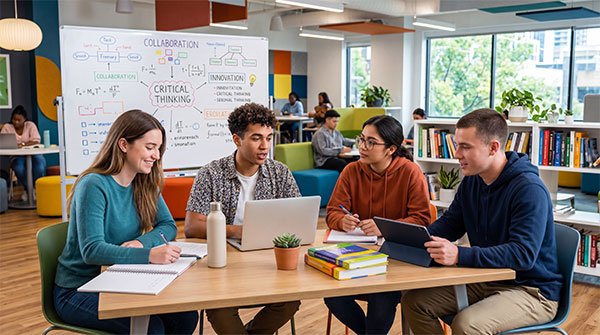
For most students, six skills give the greatest return: communication, teamwork, time management, adaptability, critical thinking and emotional intelligence. The table below is my own framework, linking each skill to everyday campus situations. It is a practical guide, not a research finding.
| Skill | Where it shows up on campus | Practise it by |
|---|---|---|
| Communication | Seminars, viva, placement interviews | Presenting once a month; joining a debate or MUN club |
| Teamwork | Group assignments, hackathons, sports | Taking a defined role and delivering it on time |
| Time management | Exams, submissions, part-time work | Weekly planning; deadlines set one day early |
| Adaptability | New course, hostel life, changed schedules | Trying an unfamiliar club or elective |
| Critical thinking | Case studies, research papers | Asking “what is the evidence?” before accepting a claim |
| Emotional intelligence | Conflict in teams, feedback, stress | Pausing before replying; asking for feedback |
An illustrative scenario (hypothetical, not a case study). Two students in a four-person project have equal technical ability. One agrees deadlines, shares updates and raises a problem early. The other works alone and surfaces issues on the final day. The group’s result depends less on their technical difference than on how they coordinate. Employers see exactly this pattern in workplaces, only with higher stakes.
How can you build soft skills during college?
You build soft skills the way you build fitness: through repeated, small practice with feedback. Reading about them helps, but it does not replace doing them.
1. Pick two skills per semester. Trying to fix everything at once fails. Choose, for example, presentation skills and time management.
2. Take a role in a club or society. Event coordination, treasury or outreach roles give real responsibility with limited risk.
3. Volunteer for the awkward tasks. Leading a group presentation or introducing a guest speaker builds confidence faster than avoidance.
4. Ask for specific feedback. “What is one thing I could do better in my presentation?” produces more useful answers than “How was it?”
5. Seek an internship or live project. Even a short one exposes you to workplace communication norms.
6. Reflect weekly. Write three lines: what went well, what didn’t, what you’ll change.
Free options include NSS, NCC, Rotaract, college fests and peer study groups. Paid options include structured courses, which the next section covers.
Do personality development classes help college students?
Expert-run personality development classes can help when they are practice-based and led by experienced trainers. They are less useful when they consist mainly of lectures or motivational talks.
A good programme gives you structured practice, such as group discussions, mock interviews, public speaking drills and body language coaching. It also gives you repeated, honest feedback, which self-study rarely provides.
How to judge a class before enrolling:
- Does it include live practice, not only theory?
- Is there feedback from a trainer on your individual performance?
- Are batch sizes small enough for you to speak regularly?
- Is the trainer’s background transparent and verifiable?
- Does it avoid guarantees such as “100% placement” or “guaranteed confidence”?
At Sanjeev Datta Personality School, our personality development classes turn theory into practice through live group discussions, mock interviews and presentation drills, so you leave with skills you have rehearsed, not just read about.
Who may not need one: students who already get regular practice through clubs, debates or internships and receive honest feedback may get similar benefits at no cost. A class is a shortcut, not a requirement.
Do soft skills start before college?
Yes. Soft skills begin forming in childhood, through family conversations, school activities, play and how adults respond to mistakes. Students who practised speaking up, sharing and handling setbacks early often arrive at college with an advantage. That said, no one is “too late”. Adults and college students can build these skills with deliberate practice.
This matters if you have a younger sibling, or if you plan to become a parent or teacher someday. Early habits such as listening, expressing feelings clearly and cooperating in groups carry forward. Age-appropriate activities like storytelling, role-play and team games are usually more effective for children than formal lectures.
Confidence isn’t built overnight, and it doesn’t have to wait for college. Our personality development for kids programme helps children build communication, teamwork and self-belief through play-based, age-appropriate activities, so they start their college years already a step ahead.
What common mistakes should students avoid?
- Treating soft skills as personality traits you either have or lack. They are learnable.
- Confusing extroversion with strong communication. Introverts can be excellent communicators, and good listening is a core skill.
- Collecting certificates without practising. Certificates show attendance. Employers test behaviour.
- Waiting until final year. Skills built over three or four years look more convincing than a last-minute crash course.
- Ignoring feedback. Defensive reactions slow improvement.
- Overpromising in interviews. Claiming leadership without an example is quickly exposed.
What are the limits of soft-skills training?
Soft skills training helps, but it has limits. Training does not replace subject competence, and no course guarantees a job. Employability data such as the India Skills Report reflects many factors, including technical skills, opportunity, region and the economy. Results also vary from person to person. Treat any programme that promises guaranteed outcomes with caution.
Key Takeaways
- The importance of soft skills in college is practical: they improve teamwork, learning, stress management and interview performance.
- Employers rank analytical thinking, resilience, leadership and self-awareness among their most valued core skills (WEF, 2025).
- India’s job-readiness rate reached 56.35% in the India Skills Report 2026, and the gap between college teaching and industry needs remains.
- Soft skills are learned through repeated practice and feedback, not just theory.
- Personality development classes help most when they are practice-based and feedback-driven.
- Building soft skills early, including in childhood, gives long-term advantages, but it is never too late to start.
Frequently Asked Questions
What is the importance of soft skills for college students?
Soft skills help students work in teams, communicate clearly, manage time and handle stress. They also affect how effectively you present your knowledge in interviews, so they support both academic and career outcomes.
Which soft skills are most important in college?
Communication, teamwork, time management, adaptability, critical thinking and emotional intelligence give most students the greatest benefit. They apply to group projects, exams, internships and placements.
Can soft skills be learned, or are they natural?
They can be learned. Some people find them easier, but practice, feedback and reflection improve them in nearly everyone. Joining clubs, presenting regularly and seeking feedback are reliable ways to start.
Do employers really care about soft skills?
Yes. In the WEF’s 2025 employer survey, resilience, flexibility, agility, leadership, social influence and self-awareness ranked in the top five core skills alongside analytical thinking.
Are personality development classes worth it?
They can be, if they include live practice, individual feedback and small batches. Check the trainer’s background and avoid programmes that guarantee jobs or transformations.
When should personality development start?
It begins in childhood, but it can start at any age. Children benefit from play-based activities. College students benefit from real responsibility, presentations and feedback.
How can I show soft skills on my résumé?
Give specific examples: “Led a five-member team to organise a 300-person event” is stronger than “good leadership skills”. Be ready to explain the situation, your action and the result in interviews.